

File Name: | Build a Production-Ready RAG System from Scratch |
Content Source: | |
Genre / Category: | |
Language: | ENGLISH |
Original Price: | $99 |
ABOUT THE COURSE:
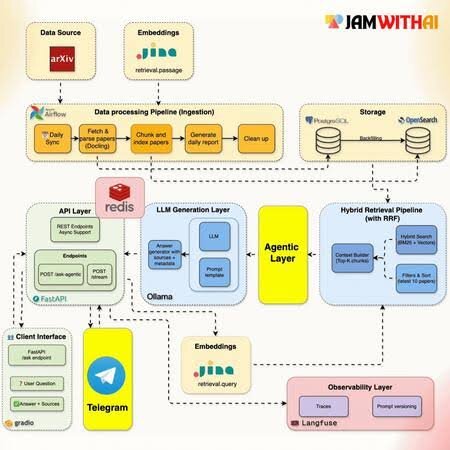
Agentic RAG System — a practical course on building a full-fledged RAG system from scratch, aimed at use in real production environments. The course is the first stage of the educational project The Mother of AI (MOAI) and covers the entire development process: from configuring infrastructure and data processing to intelligent search, language model integration, monitoring, and creating AI agents.
Over seven weeks, you will develop your own system for intelligent search and analysis of scientific publications on arXiv. The project combines automated data processing pipelines on Apache Airflow, hybrid search using BM25 and vector representations, response generation via LLM with Ollama, and agent mechanisms based on LangGraph.
Particular attention is paid to the architecture, performance, and reliability of the system. You will learn to implement streaming response generation, monitor component operation via Langfuse, use Redis for caching, and create intelligent mechanisms for query verification, document relevance evaluation, and adaptive search.
Unlike courses limited to simple demonstrations, this one covers full engineering implementation using more than 23 modern tools and technologies. You will work with actual source code, analyze architectural solutions, and learn approaches used in the development of industrial AI systems.
What You Will Learn
Infrastructure and Data Engineering
You will study the basics of building infrastructure for RAG systems, learn to deploy interconnected services using Docker, and work with FastAPI, PostgreSQL, OpenSearch, and Apache Airflow. You'll explore principles of designing reliable services, error handling, retry logic, and component health checks.
Data Collection and Processing
Learn to create automated pipelines for downloading, extracting, and processing scientific publications. You will implement integration with arXiv, process PDFs, normalize data, and store metadata. Special attention will be given to issues encountered when working with real data sources.
Intelligent and Hybrid Search
You will understand principles of full-text search with BM25, semantic search, and vector representations. You'll master strategies for chunking documents, building search indexes, and combining results from different search methods using Reciprocal Rank Fusion (RRF).
You will learn to create hybrid search mechanisms, improve result relevance, and analyze information retrieval quality.
Developing a Full-Fledged RAG System
Merge search and response generation into a unified architecture. Learn to integrate local language models through Ollama, design prompts, create API with streaming responses, and develop user interfaces for interacting with the system.
Monitoring, Performance, and Caching
Master observability and diagnostics tools for AI applications. Learn to track request execution using Langfuse, analyze delays and errors, implement caching with Redis, and optimize RAG system performance.
Agentic RAG Systems
In the final stage, you will extend the classic RAG architecture with agent capabilities using LangGraph.
You will implement mechanisms for user query verification, automatic evaluation of document relevance, query reformulation, and adaptive search. The system will be able to independently choose additional actions to improve response quality.
Learning Outcome
By the end of the course, you will have a full-fledged practical project — an intelligent assistant for searching and analyzing scientific publications that combines data processing, hybrid search, language models, and AI agents.
You will gain an understanding of how to design, develop, test, and optimize RAG systems considering real production environment requirements, and you will be able to apply the knowledge gained to create your own AI applications.
The course is suitable for Python developers, AI/ML engineers, Data Engineering specialists, and anyone who wants to move from simple LLM experiments to developing comprehensive intelligent systems.
Recommended Comments