


About This File
| File Name: | Master the First Principles of Computer Vision |
| Content Source: | https://www.ubicoders.com/foundations/robotics/cv |
| Genre / Category: | Premium courses |
| Password: |
Spoiler
pIjZyDxqQ7ByJJjY
|
| Original Price: | $190 |
| Language: |
ENGLISH |
For Paid User Without URL Shortener:
| Download : | GO TO SINGLE CLICK DOWNLOAD PAGE |
ABOUT THE COURSE:
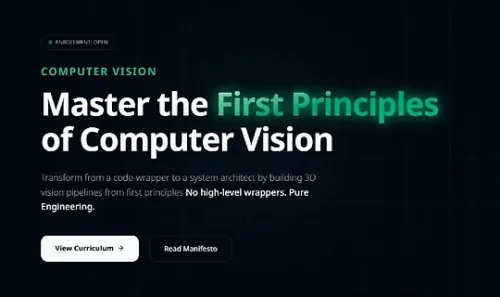
Master the fundamental principles of computer vision and build perception systems from scratch instead of using ready-made solutions.
Why understanding the basics of computer vision is important
In the internet age, many engineers mistakenly believe that it's enough to simply import a YOLO model from GitHub or use a wrapper from Hugging Face to work with computer vision systems. However, such solutions often turn the engineer into a "pixel consumer," limited to two-dimensional analysis.
Problems with the approach of ready-made solutions
Problems become apparent when conditions change: lighting, camera position, or robot movement in a new environment. Without a deep understanding of spatial geometry, such systems often end up being "blind."
An image should be considered a mathematical projection of three-dimensional reality, not just a picture.
What you will learn during the course
The course offers the understanding and creation of a complete perception system from scratch. You will delve into camera geometry and 3D reconstruction of the surrounding world.
Key topics of the course
The connection between points in real space and image pixels.
Working with camera parameters (intrinsics and extrinsics).
How the mathematical projection model turns an image into a source of spatial data.
Computer vision methods for robotics: optical flow, feature matching, triangulation, and stereovision.
Building a full 3D perception pipeline
Special attention is given to building the pipeline—from camera calibration, lens distortion correction to creating depth maps and point clouds. You will learn to transform pixels into spatial knowledge and design systems that work in real conditions.
Who the course is for
The course is designed for engineers looking to go beyond using libraries and understand the mathematics of computer vision. Ideal for those who want to design perception systems for robotics, autonomous devices, and intelligent machines.
Conclusion
By mastering the principles of camera geometry and spatial analysis, you'll be able not only to apply computer vision tools but also to create system architectures that truly understand the surrounding world.
