Paid Coding Courses
143 files
-
File Name:
Code With Antonio - Build and Deploy a SaaS AI Website Builder
Content Source:
https://www.codewithantonio.com/workshops/build-and-deploy-a-saas-ai-website-builder/
Genre / Category:
Coding Courses
Language:
ENGLISH
Original Price:
$390
ABOUT THE COURSE:
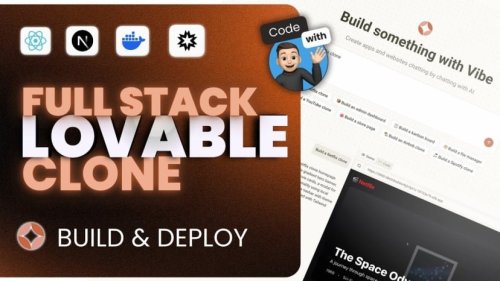
In this tutorial, we’re building an AI-powered app builder from start to finish.
You’ll learn how to generate full-stack applications from simple prompts using programmable AI agents powered by Inngest. We’ll use models like OpenAI, Anthropic, and Grok to handle code generation, and execute everything inside secure cloud sandboxes with E2B and Docker.
We’ll also cover the agent architecture, background job orchestration, project dashboard, authentication and billing with Clerk, and a full Git workflow with AI-assisted PR reviews from CodeRabbit.
Built with Next.js 15, React 19, Tailwind v4, and a fully modern AI-first toolchain.- Free
- 10 Downloads
Submitted -
File Name:
Python for Professional Developers
Content Source:
https://frontendmasters.com/workshops/professional-python/
Genre / Category:
Coding Courses
Language:
ENGLISH
Original Price:
$390
ABOUT THE COURSE:
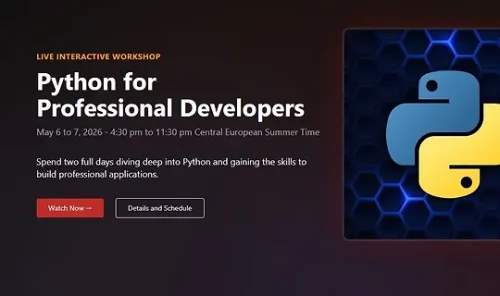
Intensive Practical Course is designed for developers experienced in other languages who want to quickly and confidently transition into the professional Python ecosystem. Over two days, you will create a full-fledged backend application, Release Tracker, on FastAPI and master key tools used in real production development.
What You Will Learn in the Course
Modern Idiomatic Python
Working with types and annotations
Exception handling and logging organization
Basics of asynchronous programming
Principles of writing readable and maintainable code
Backend Development Using the Current Python Stack
You will master the tools on which the majority of modern high-load Python services are built:
FastAPI for creating REST APIs
Pydantic for data validation
SQLAlchemy and PostgreSQL for working with storage
Organizing the project structure and transitioning from in-memory storage to a full-fledged database
Testing and Code Quality
The practical part of the course includes mastering the tools used in the daily work of engineers:
Writing automated tests with pytest
Using Ruff and mypy for static analysis
Maintaining production code quality standards
DevOps Practices and Security
Containerizing applications with Docker
Approaches to implementing authentication and authorization
Organizing secure access to APIs
Practical Outcome
By the end of the training, you will gain not only a deep understanding of Python syntax and features but also a ready production-ready backend project, created according to modern engineering standards. You will practically go through the process from API design to deploying an application in containers.
Who the Course is For
The course is optimal for developers familiar with JavaScript, Java, C#, Go, PHP, and other languages, who want to quickly learn Python through real development and professional practices. The program is suitable for those looking to transition to Python backend development or strengthen their existing expertise.- Free
- 15 Downloads
Submitted -
File Name:
Tanstack Start Course For Type-safe, Full-stack React.
Content Source:
https://jsmastery.com/course/tanstack-pro-course
Genre / Category:
Coding Courses
Language:
ENGLISH
Original Price:
₹4,284
ABOUT THE COURSE:
TanStack Start — an innovative full‑stack framework for React that changes the usual approach to development. It's not just a set of libraries, but a complete architecture created with the support of Cloudflare, Netlify, Clerk, Convex, and Neon. The course helps quickly master the technology that will become the industry standard in the coming years.
Challenges Faced by React Developers
Even with good theoretical knowledge and experience with React or Next.js, many developers face similar difficulties when creating real products:
Understanding is there, but architectural decisions are difficult
Learning materials rarely delve into real architecture. In real projects, you have to independently distribute responsibility among modules, think through the application structure, and build logic.
The code works, but feels fragile
Hydration errors, unpredictable behavior of client and server components, project overload with directives like "use client" — all this leads to a feeling of architectural instability.
No project for the portfolio
Training clones of popular services no longer impress. Employers are looking for developers who can create complete products with complex logic, integrations, and thoughtful architecture.
Practical Project of the Course — Skild
In the course, you will create a full-fledged full‑stack platform Skild — a marketplace for skills and AI agents. This is a modern project with real use scenarios that will become a significant element of your portfolio.
Within the project, you will implement:
A skill publication process with TanStack Form, Zod validation, server mutations, and notifications.
Content search and exploration with streaming loading, filtering, and pagination via URL.
SEO-optimized pages with SSR and dynamic generation of Open Graph metadata.
Integration of Firebase for storing and retrieving data.
A modern full‑stack architecture based on TanStack Start.
Why TanStack Start
Clear separation of client and server logic
Server logic is focused on routes, while components remain clean React components — without unnecessary directives and confusion.
Complete type safety
Types control the entire data path: from the server and database to the interface. Errors are caught at the development stage.
Deployment freedom
Applications can be hosted anywhere — Cloudflare, Netlify, Vercel, or your own server. No platform lock-in.
A stack supported by industry leaders
TanStack is one of the fastest-growing stacks. Companies are already investing in it today, increasing the value of skills tomorrow.
Course Program
Module 1. Introduction to TanStack
TanStack Ecosystem
TanStack Start Architecture
Key Concepts
Project Setup
Environment Preparation
Module 2. Routing
Route File Structure
Nesting Routes
Dynamic Paths
Navigation
Practical Scenarios
Module 3. Working with Data
Basics of TanStack Query
Data Fetching
Caching
Loading Strategies
Optimization
Module 4. Server Functions
Creating Server Functions
Validation
Working with Forms
Mutations
Module 5. Server Routes
Building an API
Request Handling
Integrations
Security
Module 6. SEO
SSR
Metadata and OG Data
Indexing
SEO Optimization
Module 7. Creating Skild
Application Architecture
User Scenarios
Firebase Integration
Search and Filtering
Working with Forms
SSR
Deployment
Who is this Course For
The course is suitable for you if you:
Already work with React.
Have experienced the limitations of Next.js.
Want to learn modern full-stack approaches.
Prefer learning through practice.
Are confident with TypeScript and understand the basics of backend development.
Who the Course is Not For
Beginners with no React experience.
Those looking for ready-made templates to copy.
Those who need a course on CSS or design.
Learning Outcomes
You will learn to create modern full‑stack applications on TanStack Start, confidently work with routing, server functions, SEO, and type-safe architecture.
The main outcome is a full-fledged portfolio-level project that you can showcase to employers or use as a foundation for your own product.- Free
- 10 Downloads
Submitted -
File Name:
Kubernetes. Production-Grade Container Orchestration
Content Source:
https://frontendmasters.com/workshops/kubernetes/
Genre / Category:
Coding Courses
Language:
ENGLISH
Original Price:
$390
ABOUT THE COURSE:
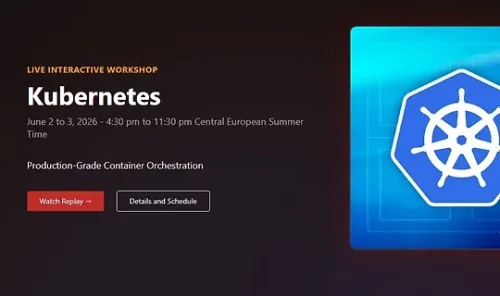
This practical course will help you confidently master Kubernetes — from local deployment in kind to a full-fledged production infrastructure in Amazon EKS. The program is built around working with a real application (Node.js/TypeScript + PostgreSQL), providing the most practical and understandable experience.
About the Course
Over two intensive days, you will step-by-step follow the path of a modern engineer working with Kubernetes: from learning basic concepts and imperative kubectl commands to implementing GitOps approaches and deployment automation. Participants will learn to create, configure, and maintain clusters necessary for the stable and secure operation of containerized applications.
Main Learning Stages
Working in a local kind cluster: basic commands, Kubernetes architecture, understanding the desired state.
Transitioning to declarative infrastructure management using Kubernetes manifests.
Configuring probes, configurations, secrets, persistent storage, and network interactions.
Setting up routing using an Ingress controller.
Studying production practices: scaling, update strategies, monitoring.
Implementing GitOps based on Argo CD and moving the application to the AWS EKS cloud.
Key Learning Outcomes
After the course, you will be able to:
Confidently apply Kubernetes concepts: desired state, reconciliation loop, controllers, and resources.
Create and maintain full-fledged Kubernetes manifests for services and applications.
Configure settings, secrets, health monitoring, and network policies.
Deploy resilient PostgreSQL clusters with CloudNativePG.
Use Kustomize to manage configurations for different environments.
Implement automatic scaling and safe update strategies.
Configure RBAC and manage cluster security.
Apply GitOps approaches using Argo CD.
Deploy and maintain clusters in Amazon EKS.
Who the Course is For
The course is designed for developers and DevOps engineers aiming to master Kubernetes on a practical level. Previous experience with Kubernetes is not required — you will learn everything from scratch, gradually moving to advanced scenarios. It is important to have confidence with Docker, Git, the command line, and AWS basics.
Prerequisites
Knowledge of Docker and containerization basics.
Confident usage of Git and the terminal.
Basic familiarity with AWS (an AWS account with administrative rights is required for the second day's practice).
- Free
- 9 Downloads
Submitted -
File Name:
DesignGurus - Grokking the System Design Interview
Content Source:
https://www.designgurus.io/course/grokking-the-system-design-interview
Genre / Category:
Coding Courses
Language:
ENGLISH
Original Price:
$150
ABOUT THE COURSE:
Grokking the System Design Interview is the most-taken system design interview course on the internet, built by ex-FAANG hiring managers. System Design Interviews test how you think about scalability, reliability, and trade-offs under pressure. Grokking System Design Interview distills the core concepts that FAANG-level engineers use every day, from load balancing and caching to data partitioning and microservices architecture. You’ll learn how to approach open-ended design questions methodically, evaluate alternatives intelligently, and communicate like a senior architect, even if you’re still mid-career. With real-world case studies, interactive diagrams, video lessons, and structured frameworks, this course gives you the confidence to design any large-scale system from scratch. DesignGurus.io is the birthplace of the 'Grokking' interview methodology. As the original authors and creators, we built the frameworks that defined modern preparation for system design. While outdated, text-only versions of our early curriculum were previously hosted on third-party platforms, DesignGurus.io is the exclusive, official home for the fully updated, expanded, and interactive version. Accept no imitations, learn directly from the architects.- Free
- 14 Downloads
Submitted -
File Name:
React Router Bootcamp: Zero to Mastery
Content Source:
https://zerotomastery.io/courses/learn-react-router/
Genre / Category:
Coding Courses
Language:
ENGLISH
Original Price:
$199
ABOUT THE COURSE:
React Router Bootcamp is a practical course on working with React Router v7 (Remix v3) that will help you confidently master modern routing and learn to build fast, flexible, and scalable web applications using React.
What You Will Learn in This Course
The course is designed to guide you gradually from the basics to advanced techniques of development with React Router v7, while simultaneously creating a real full-stack application.
Basic Concepts of Routing
understanding the principles of React Router v7;
setting up routes and navigation;
working with dynamic and nested routes.
Creating Application Architecture Based on Routes
You will learn to build the structure of an application using:
layout components and nested interface layers;
data loading logic distribution across routes;
effective responsibility distribution between pages and modules.
Working with Data and States
React Router v7 integrates routing, navigation, and data handling into a unified system. During the course, you will master:
data loading through loaders;
handling loading, pending, and error states;
data mutators and working with actions;
forms and request submissions without manual state management.
The Practical Project You Will Create
You will develop a full-fledged culinary-themed application, including:
a recipe catalog;
meal plans;
shopping lists;
convenient routing and well-thought-out structural architecture.
This will serve as an excellent portfolio project demonstrating proficiency with modern development tools.
Why React Router v7 is an Important Skill
Version v7 is rapidly gaining popularity due to its convenient API, improved architecture, and superior developer experience. You will learn to create interfaces with instant transitions, using browser capabilities and distributed systems instead of heavy static builds.
Modern UX Patterns
The course thoroughly covers:
error and loading state handling;
working with forms and actions;
creating predictable and stable UI;
organizing a comfortable user experience.
The Complete Path: From an Empty Project to Deployment
You will master the entire development cycle, including:
initializing the project;
setting up structure and architecture;
integrating client and server logic;
final deployment of the application.
Who This Course is For
The course is ideal for developers who want to:
reach a new level of React proficiency;
create faster and more efficient web applications;
work with modern tools and industry approaches;
gain practical experience applicable to real projects.
Upon completing the training, you will confidently master React Router, enhance your JavaScript and React skills, and learn to build scalable application architectures oriented towards production.- Free
- 5 Downloads
Submitted -
File Name:
Practical Go Development with AI Agents with Miki Tebeka
Content Source:
https://www.ardanlabs.com/workshops/practical-go-development-with-ai-agents/
Genre / Category:
Coding Courses
Language:
ENGLISH
Original Price:
$299
ABOUT THE COURSE:
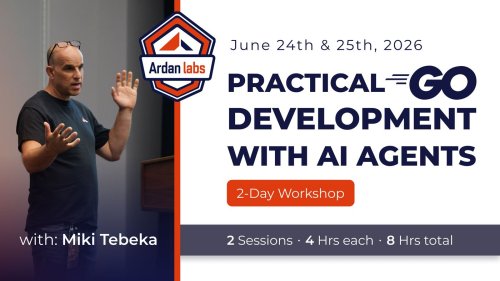
Master Practical Development in Go using modern AI agents , engineering techniques, and agentic workflows. The course will help you progress from simple autocomplete usage to comprehensive work with specifications, context engineering, planning, and code verification using AI.
An intensive 2-day practical course on Go + AI. Each session lasts 4 hours.
June 24 and 25, 2026
Day 1
Paradigm Shift: transitioning to agentic workflows and understanding the principles of coding agents.
Development Planning: creating technical specifications in a spec.md format.
Context Engineering: what and how to communicate to the agent for consistent and accurate responses.
Vertical Development and TDD: implementing features from tests to ready code.
Result Validation: code validation through tests, logs, and metrics with AI.
Day 2
Project Guidelines: creating instructions for developers and agents in AGENTS.md and CLAUDE.md files.
Extending AI Capabilities: implementing custom skills and integrating the MCP protocol.
Code Review: using agents for verification and analysis (example with roborev ).
Refactoring and Architecture Improvement: incorporating new features into existing code.
What You Will Learn
Agentic Workflows
You will gain skills in structured planning, working with specifications, and step-by-step feature delivery, going beyond mere AI prompts.
Context Engineering
Learn to provide the agent with relevant data at the right moment, minimizing the risk of hallucinations and increasing the accuracy of responses.
Skills and MCP Integration
Understand how to extend AI capabilities: adding project rules, custom skills, and integrations for solving real development tasks.
Requirements for Participation
Important: Commercial Go development experience of several months is required.
Prepare your environment and install the following before the start:
Go 1.24+ SDK
Git
Coding agent: Claude Code, Codex, Gemini, amp, opencode, or equivalent.
- Free
- 7 Downloads
Submitted -
File Name:
Agentic AI Bootcamp: AI Agents with Python, n8n, MCP & RAG
Content Source:
https://www.udemy.com/course/agentic-ai-bootcamp-ai-agents-with-python-n8n-mcp-rag/
Genre / Category:
Coding Courses
Language:
ENGLISH
Original Price:
$49
ABOUT THE COURSE:
Stop watching AI happen. Start building it.
You’ve seen what AI can do. But how do you go beyond simple prompts to build autonomous agents, scalable automations, and real business applications?
This course is the ultimate masterclass for AI Automation and AI Agents. It bridges the gap between Low-Code (n8n, Flowise) and Pro-Code (Python, Pydantic AI, Cursor), giving you the complete skillset to dominate the AI landscape in 2026.
From building local RAG systems that run on your laptop to deploying enterprise-grade Voice Agents and mastering the Model Context Protocol (MCP)—this course covers it all.
Whether you are a developer, an entrepreneur, or an automation enthusiast, you will learn how to orchestrate LLMs (like DeepSeek, GPT, Claude, Gemini) to do real work for you.
What You’ll Get:
Hands-on Projects: Build Deep Research Agents, Voice Avatars, Marketing Bots, and Lead Gen Systems & more.
Downloadable Resources: Access ready-to-use JSON workflows, Python code repositories, and System Prompts to fast-track your implementation.
Dual-Track Learning: Learn both the visual way (n8n, Flowise) and the coding way (Python, Next.js).
What You’ll Learn in This Course:
Foundations: LLMs, Setup & "Vibe Coding"
Start strong with the essential tools of the trade.
Cursor Crash Course: Master the AI code editor that writes software for you ("Vibe Coding").
AI Fundamentals: Deep dive into LLMs, Tokens, Function Calling, and "Reasoning Models" like DeepSeek R1, GPT 5.2 Thinking and OpenAI o3.
Full Stack Setup: Install Python, pip, uv, Node.js, Git, and Docker correctly to prepare your machine for AI development.
OpenAI Agent Ecosystem & Web Apps
Build official agents using the latest OpenAI tools and OpenAI Agent SDK.
OpenAI AgentKit & Agent Builder: Create agents with state variables, guardrails, and internet access.
Next.js & React Integration: Build your own Chat UI (ChatKit) and deploy custom widgets to websites.
Deep Research Agent: Build a complex agent capable of scouring the web and synthesizing reports.
Python AI Agents with Pydantic AI
Step into professional AI engineering with code.
Pydantic AI Framework: Build type-safe, robust agents using Python.
Gradio Interfaces: Create user-friendly web interfaces for your Python scripts.
Code & Deploy: Learn to publish your projects on GitHub and share them with the world.
Local AI & RAG (Privacy-First)
Run AI entirely on your own hardware—no API bills, full privacy.
Local Stack: Master Ollama, Docker, and Flowise for offline AI.
Advanced RAG (Retrieval-Augmented Generation): Set up Postgres Vector Databases, manage embeddings, and optimize chunking strategies.
LangChain & LangGraph: Understand the architecture behind modern AI chains.
Mastering Flowise: Visual AI Agents
Create powerful chatbots without writing code.
API-Powered Agents: Connect LLMs to real-world tools via API integrations.
Custom Chatbots: Build, brand, and embed RAG chatbots into WordPress and custom websites.
Sentiment Analysis: Automate customer support routing based on user emotion.
AI Automation with n8n (Low-Code)
The heart of business automation—connect everything.
n8n Fundamentals & SQL: Master the interface, variables, and connect to Supabase databases.
Advanced Workflows: Build Telegram Bots, Multi-Agent Systems, and orchestrator patterns.
Web Scraping & HTML: Turn any website content into a knowledge base for your agents.
Self-Hosting: Learn to host n8n on your own servers to save costs.
MCP: The Model Context Protocol
Learn the hottest technology in AI integration.
MCP Explained: Connect Claude Desktop, Cursor, and ChatGPT to your local tools and files.
Build Custom MCP Servers: Create your own servers in Python and n8n.
Cross-Platform Tools: Use MCP to give your agents access to Slack, GitHub, and database tools seamlessly.
Voice Agents & AI Avatars
Give your AI a voice and a face.
LiveKit & Python: Build real-time, conversational voice agents.
Telephony Integration: Connect Vapi and ElevenLabs to phone numbers for inbound/outbound calls (e.g., restaurant booking bots).
AI Avatars: Create interactive visual agents that speak to users.
Generative AI & Image Automation
Automate creativity with diffusion models.
ComfyUI Masterclass: Build complex image and video generation workflows.
Flux, Z-Image & SDXL: Run state-of-the-art image models locally.
Agentic Design: Trigger image generation automatically via n8n agents.
Building a Business & Security
Turn your skills into a profitable agency and stay safe.
Agency Blueprint: How to price, package, and sell AI services to clients.
Lead Generation: Strategies for cold outreach and social media content.
AI Security & Law: Understand GDPR, the EU AI Act, Prompt Injection, and Jailbreaking protection.
Become an Expert in the Future of Tech!
By the end of this course, you won't just understand the theory—you will have a portfolio of working agents, a deep understanding of n8n, Python, and MCP, and the business knowledge to monetize your skills.
Sign up now and start building the future!
Who this course is for:
Aspiring AI Engineers & Developers: If you know some Python (or want to learn it via "Vibe Coding" with Cursor) and want to master the modern AI stack—including Pydantic AI, MCP, Guardrails, and RAG—this course is your blueprint.
Automation Experts & No-Coders: Users of Zapier or Make who are ready to level up to n8n and build autonomous AI Agents rather than just simple linear workflows.
Entrepreneurs & Agency Owners: If you want to build and sell AI services (like Voice Agents, Support Bots, or Lead Gen Systems) to clients, this course covers the tech AND the business side (Pricing, Sales, Legal).
Product Managers & Tech Enthusiasts: Anyone who wants to understand how LLMs, Vector Databases, and Agents truly work under the hood to prototype ideas faster using OpenAI AgentKit or Flowise.
Privacy-Focused Users: Individuals who want to run Local AI (Ollama, DeepSeek) on their own hardware without relying on cloud APIs.
Creative Professionals: If you want to automate content creation using ComfyUI, Image Generation, and Video AI workflows.
- Free
- 12 Downloads
Updated -
File Name:
AWS Bootcamp: Build AI Apps with AWS Bedrock
Content Source:
https://zerotomastery.io/courses/learn-aws-bedrock/
Genre / Category:
Coding Courses
Language:
ENGLISH
Original Price:
$249
ABOUT THE COURSE:
AWS Bedrock is Amazon Web Services' fully managed platform for building Generative AI applications. It lets you work with powerful foundation models while abstracting away infrastructure complexity.
This course will take you from zero to building production-ready AI applications...even if you're completely new to Generative AI!
Projects will integrate AWS Bedrock with API Gateway, AWS Lambda, S3, AgentCore, Postman, and other essential AWS services.
Why This AWS Bedrock Course?
Well, because it's the best, most up-to-date, and practical AWS Bedrock course online that lets you get hands-on by building six AWS Bedrock projects so that you can actually use your skills in the real-world.
But of course we're biased. So here's some more details about what you'll learn in this AWS Bedrock course so that you can make up your own mind:
1. AWS Bedrock & Generative AI Foundations Understand what AWS Bedrock is, how it fits into the Generative AI ecosystem, and how modern AI applications are built using managed foundation models — explained in a beginner-friendly way.
2. Large Language Models (LLMs) Learn how LLMs work, what they excel at, and where their limitations lie. Explore real-world use cases including document understanding, chat systems, and code generation using Bedrock-hosted models.
3. Fine-Tuning & Reinforcement Fine-Tuning (RFT) Go beyond basic prompting. Learn how models can be improved using fine-tuning and RFT with human feedback, when and why to use these techniques, and how they fit into modern AI workflows.
4. Prompt Management & Optimization Design, manage, version, and optimize prompts for consistent, reliable results. Learn why prompt management becomes critical as applications scale and evolve.
5. Intelligent Model Routing Discover how to route requests intelligently between different models based on task type, cost, or quality — choosing the right model at the right time.
6. Batch Inference & Data Automation Process large volumes of data efficiently using batch inference, and automate document and data workflows using AWS Bedrock for scalable AI processing.
7. Image Generation with Diffusion Models Explore image generation concepts using diffusion models — including how to generate, control, and deploy image-based AI features at scale.
8. AI Safety, Evaluation & Watermark Detection Evaluate your LLMs for quality, accuracy, and toxicity. Understand AI safety concepts including watermark detection and responsible AI usage.
9. Serverless Deployment & Scaling Deploy Generative AI applications using a fully serverless stack — AWS Lambda, API Gateway, S3, and Bedrock — and scale AI applications without managing any servers.
10. AgentCore: From Prototype to Production Take your agents beyond local development. Learn what Amazon Bedrock AgentCore is, deploy agents on AgentCore Runtime, and monitor every tool call and decision with built-in observability — no servers to manage, production-ready from day one.
11. Agent Memory — Short-Term & Long-Term Give your agents the ability to remember. Implement short-term memory using get_last_k_turns so agents track conversation context within a session. Then add long-term memory with extraction strategies that automatically capture semantic facts, user preferences, and session summaries — so your agents personalize every interaction, even across sessions.
12. Guardrails & Responsible AI Learn how to use Amazon Bedrock Guardrails to add safety controls, filter harmful content, reduce risk, and enforce responsible AI behavior across your applications.
13. Model Comparison Compare different foundation models based on quality, speed, cost, capabilities, and use case fit so you can choose the right model for each task.
14. AWS Model Usage Quotas Understand AWS Bedrock model usage quotas, request limits, throttling, and how quotas affect real-world production applications.
15. Inference Profiles Learn how inference profiles work in Amazon Bedrock and how they help with scalable, reliable, and cross-region model invocation.
16. Marketplace Models on AWS Bedrock Explore Amazon Bedrock Marketplace Models and learn how to access additional foundation models beyond the default Bedrock catalog.
17. Advanced Bedrock Features Go beyond basic prompting and deployment by working with more production-focused AWS Bedrock capabilities used in real AI systems.- Free
- 11 Downloads
Updated -
File Name:
PyTorch for Deep Learning Bootcamp
Content Source:
https://www.udemy.com/course/pytorch-for-deep-learning/
Genre / Category:
Coding Courses
Language:
ENGLISH
Original Price:
$49
ABOUT THE COURSE:
What is PyTorch and why should I learn it?
PyTorch is a machine learning and deep learning framework written in Python.
PyTorch enables you to craft new and use existing state-of-the-art deep learning algorithms like neural networks powering much of today’s Artificial Intelligence (AI) applications.
Plus it's so hot right now, so there's lots of jobs available!
PyTorch is used by companies like:
Tesla to build the computer vision systems for their self-driving cars
Meta to power the curation and understanding systems for their content timelines
Apple to create computationally enhanced photography.
Want to know what's even cooler?
Much of the latest machine learning research is done and published using PyTorch code so knowing how it works means you’ll be at the cutting edge of this highly in-demand field.
And you'll be learning PyTorch in good company.
Graduates of Zero To Mastery are now working at Google, Tesla, Amazon, Apple, IBM, Uber, Meta, Shopify + other top tech companies at the forefront of machine learning and deep learning.
This can be you.
By enrolling today, you’ll also get to join our exclusive live online community classroom to learn alongside thousands of students, alumni, mentors, TAs and Instructors.
Most importantly, you will be learning PyTorch from a professional machine learning engineer, with real-world experience, and who is one of the best teachers around!
What will this PyTorch course be like?
This PyTorch course is very hands-on and project based. You won't just be staring at your screen. We'll leave that for other PyTorch tutorials and courses.
In this course you'll actually be:
Running experiments
Completing exercises to test your skills
Building real-world deep learning models and projects to mimic real life scenarios
By the end of it all, you'll have the skillset needed to identify and develop modern deep learning solutions that Big Tech companies encounter.
Fair warning: this course is very comprehensive. But don't be intimidated, Daniel will teach you everything from scratch and step-by-step!
Here's what you'll learn in this PyTorch course:
1. PyTorch Fundamentals — We start with the barebone fundamentals, so even if you're a beginner you'll get up to speed.
In machine learning, data gets represented as a tensor (a collection of numbers). Learning how to craft tensors with PyTorch is paramount to building machine learning algorithms. In PyTorch Fundamentals we cover the PyTorch tensor datatype in-depth.
2. PyTorch Workflow — Okay, you’ve got the fundamentals down, and you've made some tensors to represent data, but what now?
With PyTorch Workflow you’ll learn the steps to go from data -> tensors -> trained neural network model. You’ll see and use these steps wherever you encounter PyTorch code as well as for the rest of the course.
3. PyTorch Neural Network Classification — Classification is one of the most common machine learning problems.
Is something one thing or another?
Is an email spam or not spam?
Is credit card transaction fraud or not fraud?
With PyTorch Neural Network Classification you’ll learn how to code a neural network classification model using PyTorch so that you can classify things and answer these questions.
4. PyTorch Computer Vision — Neural networks have changed the game of computer vision forever. And now PyTorch drives many of the latest advancements in computer vision algorithms.
For example, Tesla use PyTorch to build the computer vision algorithms for their self-driving software.
With PyTorch Computer Vision you’ll build a PyTorch neural network capable of seeing patterns in images of and classifying them into different categories.
5. PyTorch Custom Datasets — The magic of machine learning is building algorithms to find patterns in your own custom data. There are plenty of existing datasets out there, but how do you load your own custom dataset into PyTorch?
This is exactly what you'll learn with the PyTorch Custom Datasets section of this course.
You’ll learn how to load an image dataset for FoodVision Mini: a PyTorch computer vision model capable of classifying images of pizza, steak and sushi (am I making you hungry to learn yet?!).
We’ll be building upon FoodVision Mini for the rest of the course.
6. PyTorch Going Modular — The whole point of PyTorch is to be able to write Pythonic machine learning code.
There are two main tools for writing machine learning code with Python:
A Jupyter/Google Colab notebook (great for experimenting)
Python scripts (great for reproducibility and modularity)
In the PyTorch Going Modular section of this course, you’ll learn how to take your most useful Jupyter/Google Colab Notebook code and turn it reusable Python scripts. This is often how you’ll find PyTorch code shared in the wild.
7. PyTorch Transfer Learning — What if you could take what one model has learned and leverage it for your own problems? That’s what PyTorch Transfer Learning covers.
You’ll learn about the power of transfer learning and how it enables you to take a machine learning model trained on millions of images, modify it slightly, and enhance the performance of FoodVision Mini, saving you time and resources.
8. PyTorch Experiment Tracking — Now we're going to start cooking with heat by starting Part 1 of our Milestone Project of the course!
At this point you’ll have built plenty of PyTorch models. But how do you keep track of which model performs the best?
That’s where PyTorch Experiment Tracking comes in.
Following the machine learning practitioner’s motto of experiment, experiment, experiment! you’ll setup a system to keep track of various FoodVision Mini experiment results and then compare them to find the best.
9. PyTorch Paper Replicating — The field of machine learning advances quickly. New research papers get published every day. Being able to read and understand these papers takes time and practice.
So that’s what PyTorch Paper Replicating covers. You’ll learn how to go through a machine learning research paper and replicate it with PyTorch code.
At this point you'll also undertake Part 2 of our Milestone Project, where you’ll replicate the groundbreaking Vision Transformer architecture!
10. PyTorch Model Deployment — By this stage your FoodVision model will be performing quite well. But up until now, you’ve been the only one with access to it.
How do you get your PyTorch models in the hands of others?
That’s what PyTorch Model Deployment covers. In Part 3 of your Milestone Project, you’ll learn how to take the best performing FoodVision Mini model and deploy it to the web so other people can access it and try it out with their own food images.
What's the bottom line?
Machine learning's growth and adoption is exploding, and deep learning is how you take your machine learning knowledge to the next level. More and more job openings are looking for this specialized knowledge.
Companies like Tesla, Microsoft, OpenAI, Meta (Facebook + Instagram), Airbnb and many others are currently powered by PyTorch.
And this is the most comprehensive online bootcamp to learn PyTorch and kickstart your career as a Deep Learning Engineer.- Free
- 6 Downloads
Updated -
File Name:
Automate Everything with Python
Content Source:
https://www.udemy.com/course/automate-everything-with-python/
Genre / Category:
Coding Courses
Language:
ENGLISH
Original Price:
$49
ABOUT THE COURSE:
In a fast-growing world, Python programming is becoming a must-have skill. Whether you want to automate email sending, rename 10 thousand files at once, schedule SMS, auto-start the webcam, create APIs, auto-login to websites, scrape values, and many, other cool programs, this course has it all. In the process of learning to do all those cool programs, you will master Python and will create programs with ease.
What will students learn to automate?
One of Python's strongest points is to make our jobs easier and more fun by automating tasks in any area. You will learn to send emails with attachments to hundreds of CSV contacts, automate SMS messages, filter photos from your albums, detect faces in photos and videos, spin up and deploy quick web apps, extract data from websites and PDF files, convert between different file formats, clean text using natural language processing, and many many more. At the end of the course, you will be equipped with a strong set of skills and a good GitHub portfolio.
Who is this course for?
This course is literally for anyone, from data scientists to students to doctors to musicians to new prospective programmers. With Python, you can do things from web scraping to generating music. There is always something that can be done with Python.
Do I need prior Python knowledge?
Yes. You need to know Python basics that are variables, data types, functions, conditionals, and loops. This course does not cover those because you can find such content easily on YouTube.
Can we use the apps to build our own GitHub portfolio?
Yes. You can publish the apps in your own GitHub account. However, it is recommended that you first change something from the code or even better, improve the code to make the apps really unique and yours. That will help your learning.
Do I have to follow the course in the given order?
No, you can pick the topics you like and only watch the videos and do the practice activities only for those topics.
What if I get stuck?
You will get stuck at some point. Every programmer does. When that happens, we've got your back. You can drop a question in the Q&A, and the instructor or the teaching assistant will answer your questions within the same day. You can also use the chat in the course Discord server to ask questions and chat with fellow students about Python.
What if I don’t like the course?
That will likely not happen. But, if it does, you are covered by the Udemy 30-day money-back guarantee, so you can quickly return the course. No questions asked.
Does this course cover Python 2 or Python 3?
Python 3.
What IDE/editor is used in the course?
We use the Repl IDE which is becoming a gold standard nowadays due to the share and collaborate features the IDE offers which are especially useful when you are still learning However, you are free to use your favorite IDE.
Do I need Windows, Mac, or Linux to take the course?
The operating system does not matter. You can even use a mobile device since the IDE we are using works in the browser.- Free
- 3 Downloads
Updated -
File Name:
Hitesh Choudhary - Complete React and NextJS course with AI powered Projects
Content Source:
https://www.udemy.com/course/complete-react-and-nextjs-course-with-ai-powered-projects/
Genre / Category:
Coding Courses
Language:
ENGLISH
Original Price:
$49
ABOUT THE COURSE:
This course is designed for developers who want to master React and Next.js by building real-world, full-stack AI-powered applications. Instead of learning concepts in isolation, you’ll build production-grade projects using modern tools like Convex, Supabase, Drizzle ORM, and secure payment gateways. Each module takes you from fundamentals to deployment, ensuring you understand both how things work and why they work that way.
You’ll start by strengthening your React and Next.js foundations - routing, components, server actions, caching, and performance optimization. Then you’ll move into backend development using Convex and Supabase to create scalable databases, authentication systems, and API layers. You’ll learn relational modeling with Drizzle ORM, manage global state with Zustand, or Context, and implement real payment flows using industry-standard gateways.
The course includes multiple AI-based projects where you integrate models from OpenAI, Gemini, and other providers to create intelligent SaaS applications. You’ll build dashboards, file-handling systems, chat assistants, automation tools, and more.
Finally, you’ll deploy your applications using modern hosting platforms and learn how to optimize them for real users. This is a complete, hands-on course that gives you the skills needed to build and ship full-stack, AI-driven web apps confidently.
This course is a one stop solution to master React and NextJS so that you can ship your next project with confidence!- Free
- 9 Downloads
Updated -
File Name:
Ultimate AWS Certified Security Specialty [NEW 2026] SCS-C03
Content Source:
https://www.udemy.com/course/ultimate-aws-certified-security-specialty/
Genre / Category:
Coding Courses
Language:
ENGLISH
Original Price:
$49
ABOUT THE COURSE:
Welcome! I'm here to help you prepare and PASS the newest AWS Certified Security Specialty exam.
I'm so excited to have you here, but first, let's make sure this AWS Certified Security Specialty course is the right one for you
[Jan 2026 Update]: The course is fully updated for SCS-C03
[Jun 2023 Update]: The course is fully updated for SCS-C02
-- -- -- -- -- -- --
**PLEASE READ**:
The course is MOSTLY SLIDES-BASED: If you're new to AWS, just finished AWS Certified Solutions Architect Associate and need to acquire some hands-on experience, I strongly recommend doing the following courses: AWS Certified Developer Associate, AWS Certified SysOps Administrator Associate, AWS Certified DevOps Engineer.
Expert course - you MUST have AT LEAST the AWS Certified Solutions Architect Associate: a lot of pre-requisite knowledge is assumed for that course. If you don't feel confident, please review the AWS Certified Solutions Architect Associate course first. Other certifications and extra-hands on experience is a huge plus.
This course is FAST-PACED: You must be ready to learn fast. I will not waste time over some basics. The slides are downloadable. I advise you to use the slides for some offline review after your session. I also recommend to not hesitate to go over some lectures you might have not understood fully.
NO PRACTICE EXAM INCLUDED: This course does not contain a practice exam. Please enroll in a separate course for that. This course focuses on teaching you the knowledge to ace the exam.
-- -- -- -- -- -- --
The AWS Certified Security Specialty certification is a fun certification and a challenging exam. It requires some substantial hands-on and real-world experience for you to pass. This course is going to help you solidify the knowledge you already have and put it in perspective through the study of various solutions architectures and services.
With the right dedication and thanks to this course, you should be prepared for your exam and maximize your chances of passing your AWS Certified Security Specialty certification!- Free
- 5 Downloads
Updated -
File Name:
CodeWithHarry - Complete 2026 Python Bootcamp: Learn Python from Scratch
Content Source:
https://www.udemy.com/course/codewithharry-python/
Genre / Category:
Coding Courses
Language:
ENGLISH
Original Price:
$49
ABOUT THE COURSE:
Welcome to Complete 2026 Python Bootcamp: Learn Python from Scratch! This course is your ultimate starting point to master Python and become a confident coder—whether you’re a complete beginner or looking to sharpen your skills.
In this comprehensive, step-by-step course, you’ll start with the basics and gradually progress to advanced topics, learning how to build real-world applications along the way. Python is one of the most versatile and in-demand programming languages, used in fields like web development, data science, machine learning, automation, and more. By the end of this course, you’ll have the skills and knowledge to take on professional coding challenges and start your career in tech.
What You'll Learn:
Python programming fundamentals, including variables, loops, conditionals, and data types.
How to build Python projects from scratch, including games, automation scripts, and web applications.
Object-Oriented Programming (OOP) concepts and how to apply them to real-world problems.
Debugging and problem-solving techniques to write clean, efficient code.
Practical tips and techniques to prepare for coding interviews and real-world development tasks.
Why Take This Course?
Beginner-Friendly: No prior programming experience is required.
Project-Based Learning: Gain hands-on experience by building projects that showcase your skills.
Real-World Applications: Learn Python in the context of actual use cases, from web scraping to automating tasks.
Career-Focused: Equip yourself with the skills needed to land your first job or advance your career in tech.
Whether you want to automate daily tasks, create web apps, or explore data science, this course is the perfect place to start your Python journey. Join me, and let’s transform you from a Python novice to a confident coder ready for the job market!- Free
- 23 Downloads
Updated -
File Name:
AWS EKS Kubernetes-Masterclass | DevOps, Microservices
Content Source:
https://www.udemy.com/course/aws-eks-kubernetes-masterclass-devops-microservices/
Genre / Category:
Coding Courses
Language:
ENGLISH
Original Price:
$49
ABOUT THE COURSE:
Welcome to this Amazing course on AWS EKS Kubernetes - Masterclass | DevOps, Microservices. Below is the list of modules covered in this course.
Course Modules
Create AWS EKS Cluster using eksctl CLI
Docker Fundamentals
Kubernetes Fundamentals (Pods, ReplicaSets, Deployments & Services)
EKS Storage with AWS EBS CSI Driver
Kubernetes Important Concepts for Application Deployments
Kubernetes - Secrets
Kubernetes - Init Containers
Kubernetes - Liveness & Readiness Probes
Kubernetes - Requests & Limits
Kubernetes - Namespaces, Limit Range and Resource Quota
EKS Storage with AWS RDS MySQL Database
Load Balancing using CLB & NLB
Load Balancing using CLB - AWS Classic Load Balancer
Load Balancing using NLB - AWS Network Load Balancer
Load Balancing using ALB - AWS Application Load Balancer
ALB Ingress Controller - Install
ALB Ingress - Basics
ALB Ingress - Context path-based routing
ALB Ingress - SSL
ALB Ingress - SSL Redirect HTTP to HTTPS
ALB Ingress - External DNS
Deploy Kubernetes workloads on AWS Fargate Serverless
AWS Fargate Profiles - Basic
AWS Fargate Profiles - Advanced using YAML
Build and Push Container to AWS ECR and use that in EKS
DevOps with AWS Developer Tools CodeCommit, CodeBuild and CodePipeline
Microservices Deployment on EKS - Service Discovery
Microservices Distributed Tracing using AWS X-Ray
Microservices Canary Deployments
EKS HPA - Horizontal Pod Autosaler
EKS VPA - Vertical Pod Autosaler
EKS CA - Cluster Autosaler
EKS Monitoring using CloudWatch Agent & Fluentd - Container Insights
AWS Services Covered
AWS EKS - Elastic Kubernetes Service
AWS EBS - Elastic Block Store
AWS RDS - Relational Database Service MySQL
AWS CLB - Classic Load Balancer
AWS NLB - Network Load Balancer
AWS ALB - Application Load Balancer
AWS Fargate - Serverless
AWS ECR - Elastic Container Registry
AWS Developer Tool - CodeCommit
AWS Developer Tool - CodeBuild
AWS Developer Tool - CodePipeline
AWS X-Ray
AWS CloudWatch - Container Insights
AWS CloudWatch - Log Groups & Log Insights
AWS CloudWatch - Alarms
AWS Route53
AWS Certificate Manager
EKS CLI - eksctl
AWS SNS - Simple Notification Service
Kubernetes Concepts Covered
Kubernetes Architecture
Pods
ReplicaSets
Deployments
Services - Node Port Service
Services - Cluster IP Service
Services - External Name Service
Services - Load Balancers
Services - Ingress Service
Services - Ingress SSL & SSL Redirect
Services - Ingress & External DNS
Imperative - with kubectl
Declarative - Declarative with YAML
Secrets
Init Containers
Liveness & Readiness Probes
Requests & Limits
Namespaces - Imperative
Namespaces - Limit Range
Namespaces - Resource Quota
Storage Classes
Persistent Volumes
Persistent Volume Claims
Annotations
Canary Deployments
HPA - Horizontal Pod Autoscaler
VPA - Vertical Pod Autoscaler
CA - Cluster Autoscaler
DaemonSets
DaemonSets - Fluentd for logs
Config Maps
- Free
- 9 Downloads
Updated -
File Name:
Spring & Spring Boot: AI, Security, Docker, Cloud
Content Source:
https://www.udemy.com/course/spring-framework-boot/
Genre / Category:
Coding Courses
Language:
ENGLISH
Original Price:
$49
ABOUT THE COURSE:
This course is for serious developers who are ready to take their careers to the next level. We focus on the advanced, in-demand skills of Spring Framework 6 and Spring Boot 3. This isn't a basic introduction; it's a direct path to mastering enterprise application development and getting the high-paying jobs you want.
You’ll get hands-on experience by coding every project from scratch. We start by solidifying your foundation in Spring Core, Spring MVC, and Spring Data JPA, so you're ready for any challenge. Then, we dive into the topics that will truly make you stand out. You’ll learn to secure your code with the industry-standard Spring Security, containerize your applications with Docker, and deploy them to the cloud. You'll also learn how to build scalable systems using a microservices architecture.
What makes this course unique is its focus on the future of Java. We cover the exciting new Spring AI project, giving you a significant edge in a competitive job market. This isn’t just about knowing a framework—it's about mastering a proven set of skills that will make you an expert. By the end, you'll have a portfolio of projects that demonstrate your ability to build professional, high-performing applications with Spring REST and the entire Spring ecosystem.
Topics Covered:
Spring Boot and Spring Framework 6
Spring Security
Docker
Spring AI
Microservices
Cloud Deployment
Spring Data JPA
Spring MVC and Spring REST
- Free
- 7 Downloads
Updated -
File Name:
LLMOps And AIOps Bootcamp With 8 End To End Projects
Content Source:
https://www.udemy.com/course/llmops-and-aiops-bootcamp-with-9-end-to-end-projects/
Genre / Category:
Coding Courses
Language:
ENGLISH
Original Price:
$49
ABOUT THE COURSE:
Are you ready to take your Generative AI and LLM (Large Language Model) skills to a production-ready level? This comprehensive hands-on course on LLMOps is designed for developers, data scientists, MLOps engineers, and AI enthusiasts who want to build, manage, and deploy scalable LLM applications using cutting-edge tools and modern cloud-native technologies.
In this course, you will learn how to bridge the gap between building powerful LLM applications and deploying them in real-world production environments using GitHub, Jenkins, Docker, Kubernetes, FastAPI, Cloud Services (AWS & GCP), and CI/CD pipelines.
We will walk through multiple end-to-end projects that demonstrate how to operationalize HuggingFace Transformers, fine-tuned models, and Groq API deployments with performance monitoring using Prometheus, Grafana, and SonarQube. You'll also learn how to manage infrastructure and orchestration using Kubernetes (Minikube, GKE), AWS Fargate, and Google Artifact Registry (GAR).
What You Will Learn:
Introduction to LLMOps & Production Challenges
Understand the challenges of deploying LLMs and how MLOps principles extend to LLMOps. Learn best practices for scaling and maintaining these models efficiently.
Version Control & Source Management
Set up and manage code repositories with Git & GitHub, integrate pull requests, branching strategies, and project workflows.
CI/CD Pipeline with Jenkins & GitHub Actions
Automate training, testing, and deployment pipelines using Jenkins, GitHub Actions, and custom AWS runners to streamline model delivery.
FastAPI for LLM Deployment
Package and expose LLM services using FastAPI, and deploy inference endpoints with proper error handling, security, and logging.
Groq & HuggingFace Integration
Integrate Groq API for blazing-fast LLM inference. Use HuggingFace models, fine-tuning, and hosting options to deploy custom language models.
Containerization & Quality Checks
Learn how to containerize your LLM applications using Docker. Ensure code quality and maintainability using SonarQube and other static analysis tools.
Cloud-Native Deployments (AWS & GCP)
Deploy applications using AWS Fargate, GCP GKE, and integrate with GAR (Google Artifact Registry). Learn how to manage secrets, storage, and scalability.
Vector Databases & Semantic Search
Work with vector databases like FAISS, Weaviate, or Pinecone to implement semantic search and Retrieval-Augmented Generation (RAG) pipelines.
Monitoring and Observability
Monitor your LLM systems using Prometheus and Grafana, and ensure system health with logging, alerting, and dashboards.
Kubernetes & Minikube
Orchestrate containers and scale LLM workloads using Kubernetes, both locally with Minikube and on the cloud using GKE (Google Kubernetes Engine).
Who Should Enroll?
MLOps and DevOps Engineers looking to break into LLM deployment
Data Scientists and ML Engineers wanting to productize their LLM solutions
Backend Developers aiming to master scalable AI deployments
Anyone interested in the intersection of LLMs, MLOps, DevOps, and Cloud
Technologies Covered:
Git, GitHub, Jenkins, Docker, FastAPI, Groq, HuggingFace, SonarQube, AWS Fargate, AWS Runner, GCP, Google Kubernetes Engine (GKE), Google Artifact Registry (GAR), Minikube, Vector Databases, Prometheus, Grafana, Kubernetes, and more.- Free
- 13 Downloads
Updated -
File Name:
AI Mastery: From Beginner to Pro With Powerful AI Tools by Ankit Avasthi Sir
Content Source:
https://www.baatenbazarki.com/courses/Usage-of-AI-by-Ankit-Avasthi-Sir-69987f82d5c66269a3f812b7
Genre / Category:
Coding Courses
Language:
HINDI
Price:
₹2,999
ABOUT THE COURSE:
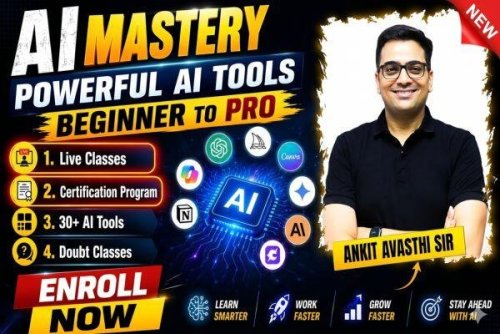
AI Mastery: From Beginner to Pro With Powerful AI Tools. The future belongs to those who know how to use AI — and this course is your gateway to mastering it.
AI Mastery is a comprehensive, hands-on course designed to take you from zero to confident AI user across 30+ of the most powerful tools available today. Unlike courses that focus on just one platform, this program introduces you to the full AI ecosystem — covering ChatGPT, Claude, Google Gemini, DeepSeek, Grok, Leonardo AI, ElevenLabs, Suno, Canva AI, Cursor, and many more.
Action-packed classes led by Ankit Avasthi Sir, you will learn how AI actually works under the hood, how to write powerful prompts, how to generate stunning images, videos, and music, how to build modern websites without writing a single line of code, and how to automate everyday tasks to save time and boost your productivity.
Whether you want to grow a YouTube channel, ace your studies, build a freelancing career, or simply stay ahead in a fast-changing world — this course gives you the practical skills and real-world workflows to do it all with AI. By the end of this course, you will be able to confidently operate multiple AI platforms, build AI-powered workflows, and stay adaptable as new tools continue to emerge.- Free
- 51 Downloads
Updated -
File Name:
Decoding DevOps – From Basics to Advanced Projects with AI
Content Source:
https://www.udemy.com/course/decodingdevops/
Genre / Category:
Coding Courses
Language:
ENGLISH
Original Price:
$99
ABOUT THE COURSE:
This course is designed for anyone who wants to start or advance their DevOps career through hands-on, project-based learning.
You’ll begin with Linux, networking, and scripting fundamentals, then progress through key DevOps tools — Git, Jenkins, GitHub Actions, GitLab, Terraform, Ansible, Docker, Kubernetes, and AWS Cloud.
Each step builds on the last with real projects, like setting up the Vprofile application across multiple DevOps stages — from on-premise to AWS to Kubernetes.
The course also introduces AI-powered tools such as GitHub Copilot, Amazon Q, and AI-integrated Helm, helping you automate faster, code smarter, and build intelligent DevOps pipelines.
And now — introducing the brand-new Monitoring & Observability section, where you’ll learn how to collect, visualize, and analyze metrics, logs, and traces using tools like Prometheus, Grafana, Loki, and Alloy.
By the end, you’ll master both the core DevOps practices and modern AI-driven workflows, preparing you for real-world cloud and automation environments.
Step-by-Step Learning Path
Step 1
Basics of Linux
Server Management in Linux
Vagrant
Basics of Networking
Project: VProfile Project Intro & Setup on VMs
Step 2
YAML & JSON
Bash Scripting (Variables, Conditions, Loops)
Automating Admin Tasks
GitHub Copilot as AI Assistant for Scripting
Step 3
Cloud Computing Intro
IAM, EC2, EBS, ELB
SSM & CloudShell Intro
AWS CLI, S3, CloudWatch, RDS, Auto Scaling, Route53
Project: Lift & Shift Web App to AWS
Re-Architecting Web App on AWS (PaaS & SaaS)
Step 4
Git & GitHub
Maven Build Tools
Jenkins (CI/CD Pipelines, Master/Slave, Nexus, SonarQube)
GitHub Actions (Workflows, Runners, Security Scans)
GitLab CI/CD (Pipelines, Stages, Docker Integration)
Step 5
Python Scripting
Automating OS Tasks
Python for AWS using Amazon Q (AI)
Step 6
Terraform Fundamentals (Variables, Modules, Backends)
Infrastructure as Code for VPC Setup
Step 7 – Monitoring & Observability
Introduction to Monitoring & Observability
Why Monitoring is Essential for DevOps
Setting up Prometheus, Grafana, Loki, and Alloy
Writing Queries with PromQL
Connecting Grafana Data Sources
Building Dashboards and Alerts
Slack Integrations for Real-Time Notifications
Integrating Loki and Alloy for Logs and Metrics
Step 8
Ansible Intro
Ad Hoc Commands, Modules, YAML Basics
Playbooks, Variables, Conditions, Loops
Handlers, Templates, Roles
Ansible for AWS Automation
Step 9
AWS (VPC Deep Dive, Lambda, Logging, Custom Metrics)
Project: CI/CD on AWS – Beanstalk, RDS, CodePipeline
Step 10
Project: Google cloud platform for multi tier app setup
GCP Cloud shell
VPC
Firewalls
VMs
Cloud SQL & Memorystore
Cloud DNS
Managed Instance groups
Secure HTTPS Load Balancers
Certificate Manager
Step 11
Docker (Containers, Images, Volumes, Networks)
Kubernetes (Setup, Objects, Autoscaling, Ingress, ConfigMaps)
Helm with AI, Lens
Project: VProfile Deployment on Kubernetes
Step 12
Project on GitOps
- Free
- 14 Downloads
Updated -
File Name:
Complete Microservices with Go
Content Source:
https://www.udemy.com/course/complete-microservices-with-go/
Genre / Category:
Coding Courses
Language:
ENGLISH
Original Price:
$99
ABOUT THE COURSE:
In this project‑driven course, you’ll build the backend microservices system for a Uber‑style ride‑sharing app from the ground up—using Go, Docker, and Kubernetes.
The course includes an introduction to Advanced Go mini-course, so you can expect the full package if you are new to Go.
By the end, you’ll have a fully deployed, horizontally scalable ride‑sharing system that’s ready for real traffic. Plus, you’ll walk away with reusable template for building future distributed projects—accelerating your path to become a lead engineer.
The project we'll build is composed of multiple services that are orchestrated with Kubernetes, you have this beautiful UI, where if you click on the map you’ll be able to preview a route to your destination and then by selecting the desired package, request a ride from a pool of available drivers.
This course aims to provide you with the foundational knowledge required to build and understand distributed backend systems, implement industry best practices, and create production-ready microservices architecture that are scalable and maintainable. It is not just a step-by-step tutorial, but a comprehensive learning experience that prepares you for real-world scenarios.
- Free
- 8 Downloads
Updated -
File Name:
OpenClaw: Run Powerful & Autonomous AI Agents Securely
Content Source:
https://www.udemy.com/course/openclaw-run-powerful-autonomous-ai-agents-securely/
Genre / Category:
Coding Courses
Language:
ENGLISH
Original Price:
$99
ABOUT THE COURSE:
Stop renting AI. Start owning your digital workforce.
You’ve used ChatGPT, Claude, Gemini, maybe also n8n, and you’ve seen AI agents. But have you ever had a true AI Employee that lives on your server, manages your files, codes itself, and pings you on Telegram when the job is done?
Welcome to the OpenClaw Masterclass.
This course is your blueprint for building a fully autonomous, privacy-focused AI ecosystem. Whether you want a local assistant running on your laptop or a 24/7 digital worker on a VPS, OpenClaw is the framework that makes it happen.
We move beyond simple "chat" interfaces. You will learn to deploy OpenClaw, an agent with a Soul, a Heartbeat, and a distinct Identity. It doesn't just answer; it proactively works for you using tools and memory files that you control.
You will learn how to orchestrate LLMs to hear you (Whisper), see your files, execute commands, and even manage other AIs (like Claude Code, OpenCode or Codex) to write software.
What You’ll Get:
Real-World Deployments: Set up OpenClaw locally (Windows/Mac/Linux) or as a remote VPS employee.
The "Soul" Architecture: Deep dive into the configuration files (Soul, Identity, User) that make your agent unique.
Custom Skills: Build agents that can send emails, generate images locally, browse the web, and manage your calendar.
Cost-Saving Strategies: Learn smart model routing, prompt caching, and local model integration to run AI almost for free.
Security Best Practices: Complete guides on firewalls, SSH hardening, and safe skill installation.
What You’ll Learn in This Course:
Foundations: The OpenClaw Ecosystem
Start strong by setting up your command center.
Universal Installation: Master the setup on Linux, macOS, Windows, or Docker.
Onboarding: Configure Telegram, WhatsApp, iMessage or Slack to be your primary interface and control your AI from anywhere in the world.
Hooks & Plugins: Configure Hooks so OpenClaw "remembers" you and proactively notifies you via Telegram when tasks are done.
Designing the AI's Personality (The Core Files)
Don't just build a bot—create a digital being.
The Soul File: Learn to write the DNA of your agent. Define its core purpose, ethical boundaries, and personality traits.
The Identity File: Give your agent a specific persona and tone.
The User File: Teach the agent who you are. Store your preferences, bio, and working style so the AI adapts to you.
The Agent File: The operational brain. Define how the agent processes information and prioritizes tasks.
The Heartbeat: The rhythm that keeps your agent alive. Configure the Heartbeat file to trigger background tasks and autonomy.
Local Power: Privacy, Voice & Vision
Turn your local machine into an AI powerhouse.
File System Mastery: Give OpenClaw the ability to access, organize, and modify your PC files remotely.
Voice Input: Talk to OpenClaw naturally using Whisper and FFmpeg integration.
Local Image Generation: Create custom Tools to trigger ComfyUI workflows directly from your chat.
Agentic Coding: Watch OpenClaw modify its own settings and orchestrate tools like Claude Code or Codex for software development.
Context Management & Cost Optimization
Make your AI smarter while spending less.
Ollama Integration: Run models offline, privately, and for free using your own hardware.
Context Engineering: Master context files and sessions so your agent "remembers" complex projects without hallucinating.
Smart Economics: Implement prompt caching, smart model routing, and "lean init" strategies to drastically reduce API bills.
The VPS Employee: 24/7 Automation & DevOps
Deploy a separate digital employee that works while you sleep.
VPS Deployment: A step-by-step guide to hosting OpenClaw on a Virtual Private Server.
Google Cloud & Email: Automate your inbox and integrate deeply with Google Services.
Deep Research: Enable web fetching and browser automation (via Brave, Playwright & Perplexity) to have your agent scour the internet for you.
Cron Jobs & Cronos: Set up complete automated schedules: Your agent wakes up, does the work, and reports back.
Advanced Security & The Future
Protect your digital asset and stay ahead.
Server Security: Learn essential DevOps skills: Closing ports, configuring firewalls, and securing SSH to keep your agent safe.
MoltBook: Discover the "New Internet for AI Agents" and how to leverage it.
Skill Expansion: Learn the difference between safe and unsafe skill installation methods.
Become the Architect of Your Own AI Force!
By the end of this course, you won't just be using AI... You will be managing a robust, autonomous system that works for you. You will understand how to manipulate the Soul file to change behavior, how to use the Heartbeat to create autonomy, and how to secure your digital employee.- Free
- 9 Downloads
Updated -
File Name:
Machine Learning A-Z [2026]: ML, DL, AI with AWS, Python & R
Content Source:
https://www.udemy.com/course/machinelearning/
Genre / Category:
Coding Courses
Language:
ENGLISH
Original Price:
$99
ABOUT THE COURSE:
This course has been designed by two AI & Machine Learning experts so that we can share our knowledge and help you learn complex theory, algorithms, and coding libraries in a simple way.
We will walk you step-by-step into the World of Machine Learning. With every tutorial, you will develop new skills and improve your understanding of this challenging yet lucrative sub-field of Data Science.
This course can be completed by doing either the AWS tutorials, Python tutorials, or R tutorials, or the three of them - AWS, Python & R. Pick the ones you need for your career.
This course is fun and exciting, and at the same time, we dive deep into Machine Learning. It is structured the following way:
Part 1 - Data Preprocessing: Importing the dataset with pandas, Matrix of Features and Target Vector, Training & Test Sets, Imputing Missing Data, Encoding Categorical Variables, Feature Scaling
Part 2 - Regression: Simple Linear Regression, Multiple Linear Regression, Polynomial Regression, SVR, Decision Tree Regression, Random Forest Regression
Part 3 - Classification: Logistic Regression, K-NN, SVM, Kernel SVM, Naive Bayes, Decision Tree Classification, Random Forest Classification
Part 4 - Clustering: K-Means, Hierarchical Clustering
Part 5 - Association Rule Learning: Apriori, Eclat
Part 6 - Reinforcement Learning: Upper Confidence Bound, Thompson Sampling
Part 7 - Natural Language Processing: Bag-of-words model and algorithms for NLP
Part 8 - Deep Learning: Artificial Neural Networks, Convolutional Neural Networks
Part 9 - Dimensionality Reduction: PCA, LDA, Kernel PCA
Part 10 - Model Selection & Boosting: k-fold Cross Validation, Parameter Tuning, Grid Search, XGBoost
Part 11 - ML Data Preprocessing with AWS: Data types (Apache Parquet, JSON, CSV), Data Preparation with S3, ETL with AWS Glue, Data Wrangling with AWS Glue DataBrew & SageMaker Data Wrangler, Feature Engineering with SageMaker
Part 12 - ML Model Development with AWS: XGBoost, LightGBM, CatBoost, Ensemble Models, Hyperparameter Tuning Techniques, Building Ensemble Models for Regression & Classification with Amazon SageMaker AI, Natural Language Processing with Amazon Comprehend, Computer Vision with Amazon Rekognition, Text to Speech with Amazon Polly, Speech To Text with Amazon Transcribe, Text Extraction with Amazon Textract, Machine Translation with Amazon Translate
Part 13 - ML Model Deployment with AWS: Methods for Deploying Models in Production, Deployment in Amazon SageMaker AI, Serverless vs. Real-Time vs. Asynchronous Inference, Deployment Endpoints in Amazon SageMaker, SageMaker vs. ECS vs. EKS vs. Lambda Deployment Targets, CloudFormation & Cloud Development Kit (CDK), Elastic Container Registry (ECR), Elastic Container Service (ECS) & Fargate, Building Containers with Amazon ECR, ECS & EKS
Part 14 - ML Workflow Automation (CI/CD Pipelines) with AWS: AWS CodePipeline, AWS CodeBuild, AWS CodeCommit, AWS CodeDeploy, Creating an ML pipeline with Amazon SageMaker Pipelines
Part 15 - ML Solution Monitoring and Maintenance with AWS: Features of Responsible AI, Legal Risks of Generative AI, Tools for Responsible ML, Model/Data Quality and Bias Drift with SageMaker Clarify, Monitoring Models in Production with SageMaker Model Monitor, SageMaker Model Cards, SageMaker Inference Recommender, SageMaker Savings Plans
- Free
- 16 Downloads
Updated -
File Name:
Cloud CI/CD with GitHub Actions
Content Source:
https://frontendmasters.com/workshops/github-actions/
Genre / Category:
Coding Courses
Language:
ENGLISH
Original Price:
$39/Monthly.
ABOUT THE COURSE:
Practical Course on GitHub Actions , where you will step by step create a full-fledged cloud CI/CD pipeline and master both basic and advanced automation techniques . The material is adapted for projects in any language and is suitable for both developers and DevOps engineers.
What You Will Learn in This Course
The training is built around real scenarios of using GitHub Actions. You will learn the key components of the platform and be able to confidently create, optimize, and secure pipelines of any complexity.
Basics of GitHub Actions
Events, workflows, jobs, steps, and runners
YAML syntax and pipeline structure rules
Creating your first working workflow
Advanced CI Techniques
Matrix builds for parallel testing
Caching dependencies to speed up the pipeline
Composite actions and reusable workflows
Connecting cloud providers through OIDC
Security and Debugging
Proper handling of secrets
Environment protection settings and permission restrictions
Debugging and optimization tools
Supply chain security practices
Who the Course is For
The course is designed for developers and DevOps engineers who want to systematically build CI/CD processes based on GitHub Actions. No special experience is required — basic Git and command line skills are sufficient.
What the Learning Outcome Will Be
After the course, you will be able to design production-ready pipelines, optimize current processes, and implement a modern approach to automation for any projects - from pet applications to corporate solutions.- Free
- 12 Downloads
Updated -
File Name:
The Computer Vision Bootcamp
Content Source:
https://zerotomastery.io/courses/computer-vision-bootcamp/
Genre / Category:
Coding Courses
Language:
ENGLISH
Original Price:
$199
ABOUT THE COURSE:
Computer vision is a field of artificial intelligence that teaches computers how to interpret and understand images and video. That means instead of just storing visual data, a computer vision system tries to answer questions about what’s in it, like identifying objects, tracking movement, recognizing faces, reading text, or segmenting parts of an image.
In practical terms, computer vision is what powers things like self-driving cars, medical image analysis, facial recognition, quality inspection in manufacturing, image labeling tools, and more.
In short, it helps machines turn pixels into useful information they can act on.
But this course is for learners who want more than just understanding what computer vision is. You’ll dive deep into computer vision models, understand the math that makes them tick, learn how modern computer vision systems are actually built, and even build your own production-ready computer vision applications with AWS.- Free
- 9 Downloads
Updated -
File Name:
Azure Bootcamp: Build AI Workflows & Agents with Microsoft Foundry
Content Source:
https://zerotomastery.io/courses/azure-ai-bootcamp/
Genre / Category:
Coding Courses
Language:
ENGLISH
Original Price:
$249
ABOUT THE COURSE:
AI is quickly becoming a real part of enterprise software.
Not just chatbots. Not just API calls. Real systems that can reason through tasks, use tools, follow workflows, and hand decisions back to humans when it matters.
In this course, you’ll be introduced to the fundamentals of Azure's most powerful AI tool: Microsoft Foundry (formerly Azure AI Studio).
You’ll start with the core ideas behind agents: what makes them different from traditional automation, how they communicate, and how they connect to business systems. Then you’ll set up a complete development environment with Azure AI, the CLI, VS Code, the AI Toolkit, and Python.
From there, you’ll build toward something practical: a human-in-the-loop content pipeline where agents generate and refine work while approval steps, conditions, and regeneration loops keep the process controlled.
By the end, you’ll understand what it actually means to build AI agent workflows for production-style environments.- Free
- 5 Downloads
Updated





.thumb.webp.beddc88da3ae5f7baa8546c224e8fdc8.webp)